
Seaside City Directory Holdings, Year by Year
The best documented Seaside city directory run is Polk's Monterey Peninsula directory, which explicitly includes Seaside with Monterey, Carmel, Del Rey Oaks, Pacific Grove, and Sand City. For Seaside family research, the shelf record at Monterey Public Library gives a usable starting point, but the collection is not an annual run. Other Seaside sources fill different gaps: Haines supplies an address-oriented criss-cross approach, while newspapers, maps, yearbooks, and historical indexes provide context rather than a duplicate resident list.
| Collection | Years or coverage | Where held | Access and use |
|---|---|---|---|
| Polk's Monterey Peninsula directory | 1926, 1930, 1937, 1939, 1941, 1947, 1949, 1951, 1953, 1954/55, 1956-60, 1962-82, 1985, 1987 | Monterey Public Library California History Room, call 917.9476 POL[K] | Alphabetic and reverse-address sections; consult the library |
| Haines Monterey, San Benito, Santa Cruz city and suburban criss-cross | Exact shelf years not exposed online | Monterey Public Library, call 917.9476 HAI | Confirm the exact years with library staff |
| Seaside Sentinel and Monterey County Herald microfilm | Exact reel coverage varies | MCFL Seaside Branch and system | Obituaries, social news, business, legal notices, and address context |
| Fort Ord yearbooks | 1952-1975 | CSUMB Digital Commons | Every CSUMB-held yearbook in the run is digitized |
| Peninsula Diary and Noticias | 2,500+ columns from 1949-1970; Noticias 1957-2009 with 100+ indexed | Monterey History and Art Association | Searchable historical names, places, and stories |
The verified Polk list is missing 1961, 1983 and 1984 as a pair, and 1986. The Seaside publication year is a snapshot. It is not a move-in date, a move-out date, or proof that a person remained at the address between editions.
Seaside Polk Shelf and Directory Gaps
R.L. Polk & Co. of South El Monte published the Monterey Peninsula volumes identified by the Monterey Public Library house-history guide. The verified Seaside-inclusive shelf begins in 1926 and extends through 1987 with the gaps listed above. For a Seaside address, that is the earliest Seaside-inclusive run verified in the library inventory, not a claim that no earlier directory ever existed. The distinction keeps a city directory search honest when a family story points to an earlier date.
Each available Seaside edition should be logged by publication label, not silently turned into an annual sequence. If a name appears in 1953 and again in 1956, the blank years remain unknown. Check the next available Polk volume, then move to Haines, the Seaside Sentinel, the Monterey County Herald, Sanborn maps, or a deed record. A gap can reflect a missing shelf volume, a move, a change in spelling, or a person who was not listed.
Where Seaside Directory Evidence Lives Today
Monterey Public Library's California History Room is the primary shelf for the Polk collection. The Haines call number is 917.9476 HAI, but its exact years must be confirmed with staff. Monterey County Free Libraries adds a local Seaside research layer at the Seaside Branch, 550 Harcourt Avenue. Published contact details are 831-899-8222 and 611-secirc@co.monterey.ca.us. Its microfilm holdings include the Seaside Sentinel, Monterey County Herald, California Census, Great Register of Voters, Sanborn maps, Pacific Appeal, and Negro History Bulletin.
MCFL's Seaside local-history page describes more than 2,000 digital objects. Marina Administrative Office materials require an appointment at 831-883-7512 or KrajeskiJ@countyofmonterey.gov. High-resolution copies cost $20 for personal or research use and $35 for publication or commercial use. Californiana, about 3,000 noncirculating volumes, is available at the Prunedale Branch by appointment at 831-796-3080. These routes matter when a printed Seaside volume is only one part of a house or family file.
Reading a Seaside Directory Volume
A printed Seaside directory entry is compact. The library guide describes an alphabetic resident listing with a resident name, occupation, and spouse, followed by the address. The back of the volume reverses the path: start with a Seaside street address and look for the printed occupant. Later editions may add a telephone-number cross-reference. Do not add an ownership or widow notation unless an edition in hand actually prints it.
| Resident name | Use the Seaside name exactly as printed, including initials, compound surnames, or spelling differences. |
|---|---|
| Spouse | Record a spouse only when the entry prints one. |
| Occupation | Capture the stated occupation as a period clue, not as a complete identity test. |
| Alphabetic placement | Note the surname order and any nearby entries that may help with a same-name problem. |
| Street address | Preserve the Seaside house number and street spelling as printed. |
| Reverse address | Use the back section to connect the address with its publication-year occupant. |
| Telephone cross-reference | Use it only when the later edition supplies that feature. |
- Criss-cross directory
- The reverse-address half of a printed directory, arranged by street so an address can lead to an occupant.
- Householder index
- A plain-language name for the alphabetic resident listing used to find a household entry; verify the volume's own labels before quoting it.
- Abbreviation key
- An edition aid, when supplied, that expands printed shorthand. Photograph or transcribe it before interpreting a short mark.
Reverse Addresses in Seaside Polk and Haines
The reverse section is the bridge between a Seaside street and a historical household. Normalize the address without erasing the original spelling, then inspect the matching line in Polk. Read the alphabetic entry for the name, spouse, and occupation. Check the adjacent addresses for block context, but do not assume that a nearby name is part of the same household. Haines can help when a Polk volume is missing, though its exact shelf years are not exposed online.
A reverse-address hit is still a Seaside publication-year snapshot. Compare the prior and next available edition. If the name disappears, test the next source: the Seaside Sentinel or Herald for an obituary or legal notice, a Sanborn map for the structure and street context, or a recorded instrument for title history. Modern parcel work belongs in the address-keyed workflow on the Seaside street directory page, while this page keeps the historical shelf in view.
Following Seaside City Directories Through Family History
A printed directory can place a person in a Seaside address during a particular publication year. For Seaside family history, it becomes more useful when paired with a census, newspaper, deed, map, or family document that supplies a second date or relationship. The public federal census reaches through 1950 in 2026 under the 72-year rule; the 1960 census is scheduled for release in 2032. Use those years as comparison points, not as replacements for the directory.
- Start with a known Seaside name, address, or date, and write down every spelling variant before opening a volume.
- Find the name in the alphabetic section, then capture the spouse, occupation, address, and exact publication year.
- Flip to the reverse-address section and compare the same address with nearby lines.
- Pair available directory years with the 1930, 1940, and 1950 federal census schedules where the household fits.
- Use Seaside newspapers, probate, deeds, or a later directory to test what happened after a name disappears.
Do not read a missing entry as proof of death or departure. It may reflect a volume gap, a changed spelling, an unlisted person, or a move beyond the volume's coverage.
Fort Ord's Seaside City Directory Trail
For a Seaside military-family or classmate search, the Fort Ord collections add a human-use layer that a property record cannot. CSUMB's Fort Ord digital collection includes oral histories, photographs, postcards, schematics, and murals. The separate Fort Ord yearbook collection states that every yearbook held by the CSUMB Archives is digitized, covering 1952-1975. Names and images can connect a Seaside person to the base without pretending that a yearbook is a current address record.
The Fort Ord collection shown below places the directory shelf in the setting that drove much of Seaside's twentieth-century population and gives a researcher another period source to compare with a printed name.
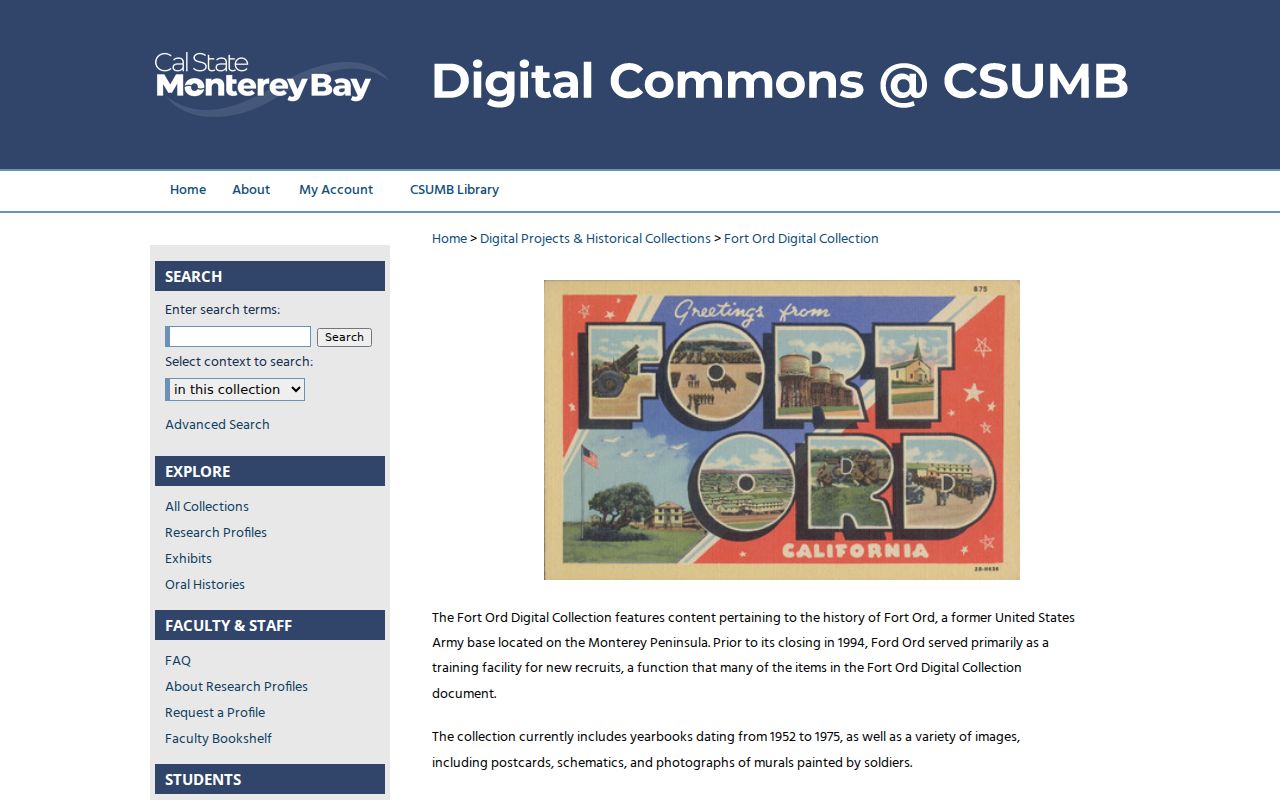
Its value for Seaside research is strongest when a directory name, a yearbook caption, and a newspaper or family source agree on the same time and place.
The digitized Fort Ord yearbooks add a second Seaside view of the same era. Their names and images can help reconnect a classmate or military family to a publication year.
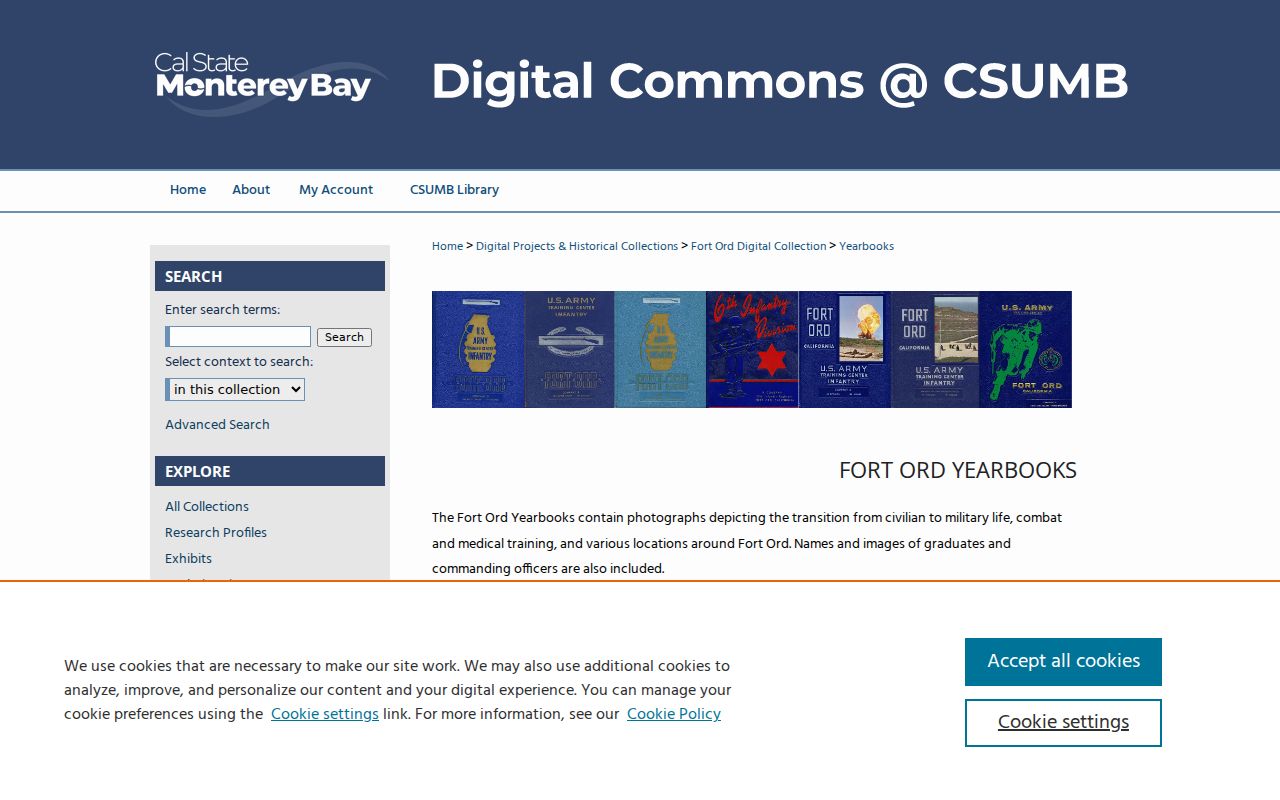
A yearbook caption is a historical clue, not a current resident record. Compare it with a directory, newspaper, or family source before treating a match as settled.
Seaside City Directory History Indexes
The Monterey History and Art Association advanced index at MHAA Advanced Search offers optional fields for Name, Exact Last Name, Role, Building, Organization, Location, Topic, Publication, and Notes. Partial words work, while quotation marks narrow a phrase. For Seaside names, its Peninsula Diary collection contains more than 2,500 Mayo Hayes O'Donnell columns from 1949-1970. Noticias runs from 1957-2009, with more than 100 items indexed and almost all issues available as PDFs.
The MHAA historical index shown below can find a Seaside story, role, building, or organization. Read the cited publication rather than treating an index hit as a full resident profile.
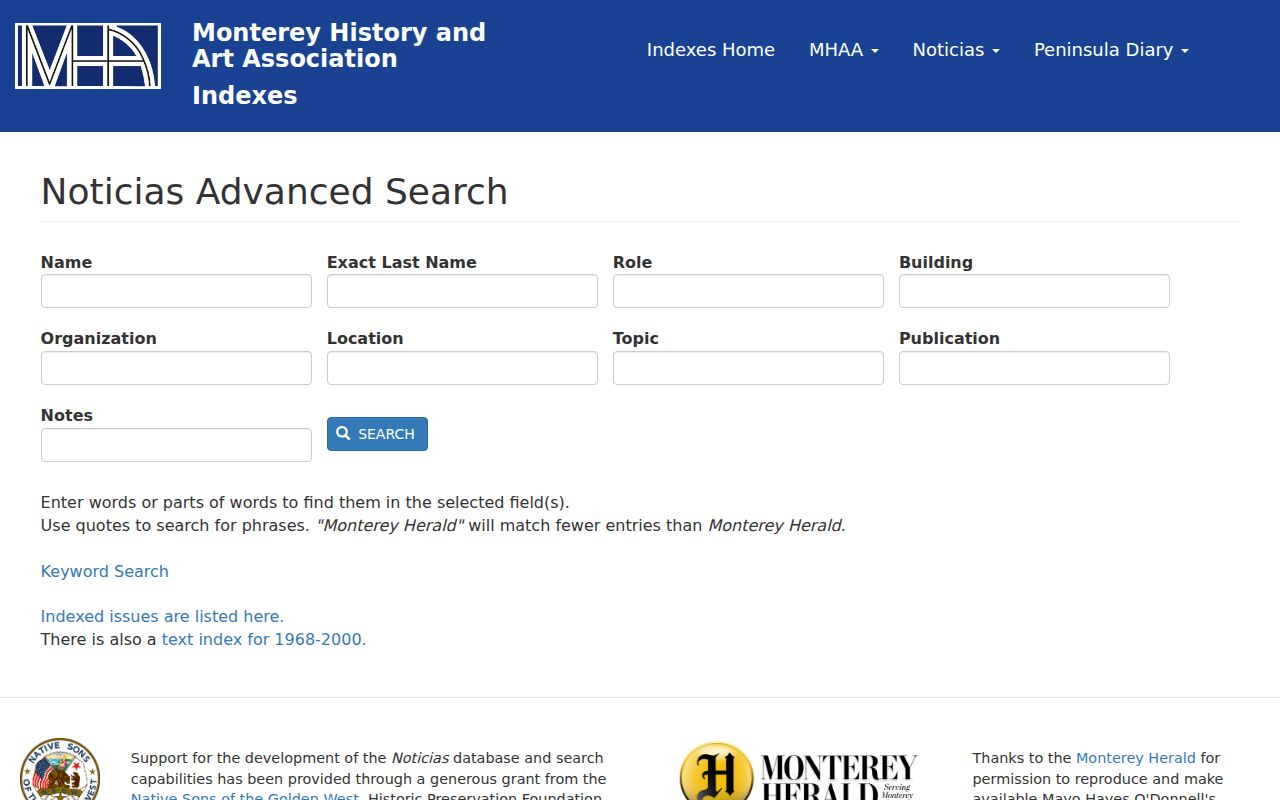
MHAA research is arranged through its library and contact channels, including 831-747-1027 for noncirculating research. A partial-name hit can be a lead for a family history file, not a substitute for a custodian-held record.
When a Seaside Directory Year Is Missing
Missing Seaside years are a research condition, not an invitation to fill a blank with a guess. Start with adjacent Polk editions and confirm the exact Haines shelf years with Monterey Public Library. Then check Seaside Sentinel and Monterey County Herald microfilm for obituaries, social notices, business references, and legal notices. Sanborn maps can show a building footprint or use, while a deed's legal description can preserve parcel identity when an address changes form.
The State Library genealogy collections at California Library genealogy and the National Archives census guide at Archives census research offer wider routes. Keep a Seaside gap note that says which volume, reel, or index was checked. That small habit prevents a later reader from mistaking an unavailable edition for evidence that no household existed.
Seaside's Directory Story Follows Fort Ord
Seaside's local record story runs through several population waves. Subdivision activity began in 1887, the Seaside name and post office followed by 1891, and Fort Ord had a training presence in 1910. The base expanded after 1941, integrated in 1948, and closed in 1994. Seaside incorporated in 1954. Those dates explain why a Seaside directory trail can shift from early subdivision and shoreline context to wartime military households and then to former-base redevelopment.
A printed city directory remains a snapshot within that Seaside story. Read it beside the library's microfilm, the Fort Ord yearbooks, and the local history indexes, while keeping the publication year and source location attached to every claim.